


 Modern technology has rewired our expectations, and today’s end-users demand flawless mobile service everywhere, allowing them to browse online whenever they please or stream high-quality content without buffering interruptions. Users must take in everything the moment they want it with zero hiccups from their wireless network. And while the wireless signal may be the last part of the transmission, getting data to the antenna takes a rock-solid physical network underneath it all.
For service providers and installers, delivering this experience means building and maintaining a network with many moving parts. That’s where vocabulary matters. Backhaul, fronthaul, and midhaul are more than buzzwords – they’re the distinct paths that keep your network operational and your latency low.
Knowing the terms is the easy part, but the real work is in how you build each of these parts of the wireless cell site. Historically, this space has been defined by proprietary systems and vendor lock-in, but today, a new approach centered on reliability and interoperability is changing the game from day one.
What is the Anatomy of a Wireless Cell Site?
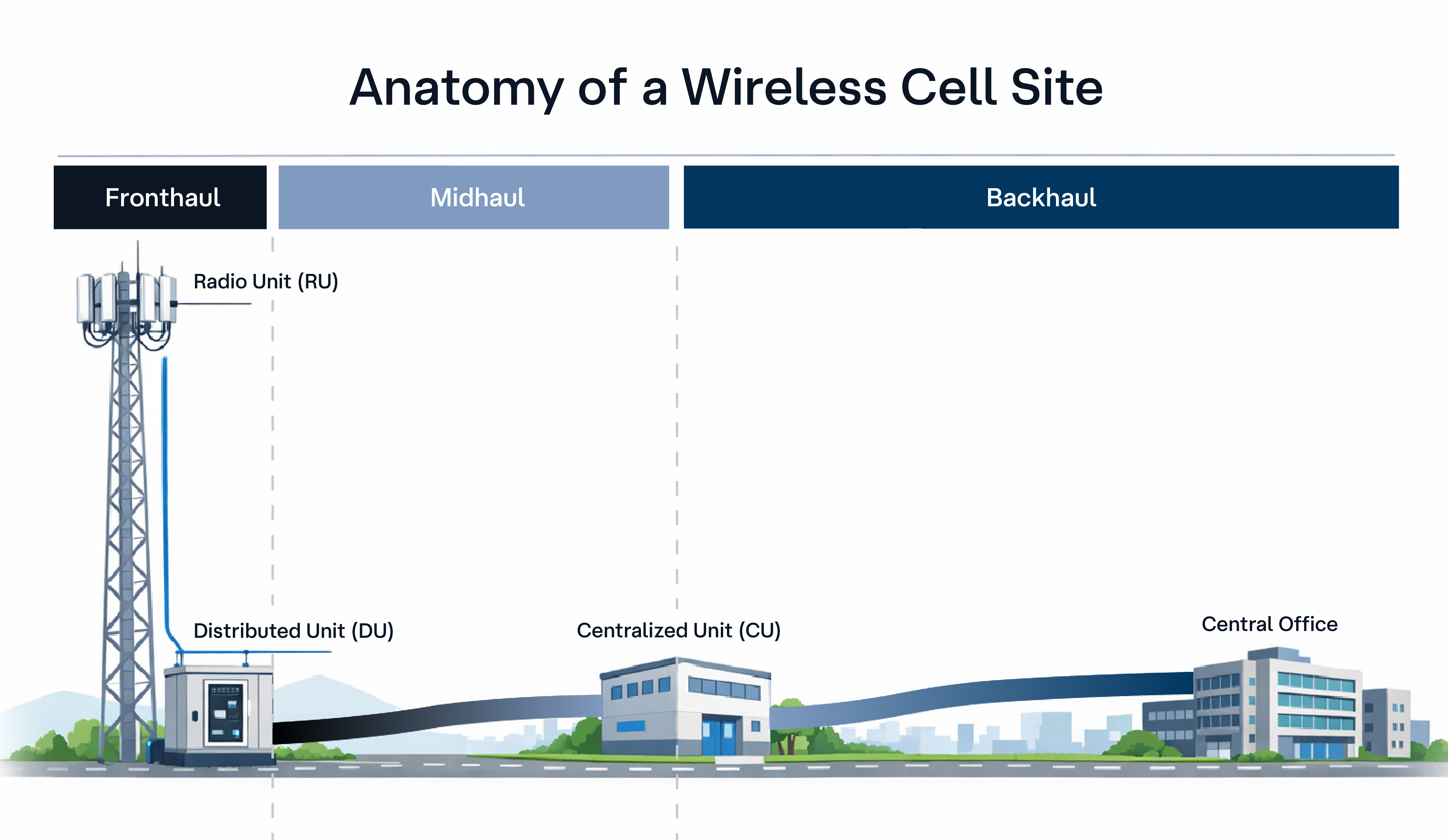
First, let's break down a typical wireless network anatomy, starting from the antenna and working our way backward.
- Fronthaul: This is the short but critical connection between the radio unit (RU) at the top of the tower to a weather-hardened cabinet or hut at the base. This cabinet contains the baseband or distributed unit (DU) modules that process all the radio traffic, fronthaul switches or routers that handle high-speed CPRI or eCPRI streams, and the power systems that keep everything running.
- Midhaul: More than a “plan B when there’s no fiber,” midhaul is the link between the DU at the tower and a centralized unit (CU), often located in a small data center or aggregation site. It comes into play when operators split and centralize RAN functions, which allows them to simplify upgrades and prep for technologies like virtualized (vRAN) or cloud RAN (cRAN). Because midhaul can ride over fiber or high-capacity microwaves, it enables a flexible, scalable RAN architecture.
- Backhaul: This is the high capacity "highway" that connects the RAN to the core network. It aggregates traffic from multiple sites and carries it back to central offices (CO) or core data centers over fiber. Here, performance, availability and latency define whether you’ll be able to keep up with video, IoT and increasing AI traffic.
- Backbone: Think of this as the destination. It’s where everything converges – large-scale regional or national transport networks interconnecting core sites, data centers and peering points. Backhaul and midhaul links all feed into this mesh. Think of backbone as the unseen infrastructure that makes “always on” connectivity possible.

Importance of Reliable Wireless Components in the Passive Infrastructure
What is one of the most expensive events in a network? The truck roll. The radios and routers may grab the spotlight, but it’s the passive infrastructure that determines whether a site stays online or goes dark. This is especially true in the fronthaul, where equipment is exposed to wind, rain, heat and the elements.
This is where Belden's expertise in passive components becomes critical. The challenge we solve is simple – keep the site running no matter what. We do that by supplying passive wireless components that are tested and proven to withstand the environment and keep the active parts working flawlessly.
- Rugged Climate-Controlled Cabinets
- Reliable Outdoor Cabling
- Tower-Mounted Protection
At the base of the tower, network operators need large, climate-controlled metal cabinets to protect the active equipment, complete with air conditioning, heaters, and battery backup space. With a NEMA 3R and 4-rated design, the PPC Outdoor Wireless Cabinet delivers this fortress-like protection. Constructed from durable .125” powder-coated aluminum, it comes field-ready with features like filtered louvers and 26 RU of rack space to accommodate and cool a wide range of active components.
A necessity for delivering power and data are hardened fiber and power cables – often combined into hybrid cable assemblies – that run up the tower to power the radios. The PPC Outdoor Wireless Hybrid Trunk Assemblies streamline deployments by providing reliable power and fiber optic connections to wireless radios and terminals. Hybrid trunk assemblies reduce the installation time, cost, and complexity of wireless installations. With pre-connectorized fiber connections, the assembly eliminates the need for complex, on-site splicing.
Up on the tower itself, specialized terminals and junction boxes distribute the fiber and power, such as hybrid OVP (Overvoltage Protection) terminals that have lightning protection built right in. For example, the Hybrid Fiber Power OVP Terminal protects up to six radios using robust, integrated Type 2 surge protection devices and can be easily swapped in the field. The NEMA 4X enclosure ensures a weather-tight seal, while visual indicators on the surge protection devices allow crews to instantly verify protection status.
You can’t have a reliable active network without a solid passive foundation that will withstand the harshest weather from hurricanes to blizzards.
How Does Open RAN Allow for End-to-End Solutions Suppliers?
We’ve talked about the passive pieces of the wireless network, but in addition come the active pieces, bringing the entire Belden broadband portfolio together to solve the whole puzzle. Between the PPC and Precision OT brands, we offer a complete, end-to-end solution across both passive and active equipment that provides both reliability and choice for wireless network providers.
While our high-performance optical transceivers are already a key player in the backhaul, the rise of Open RAN (O-RAN) opens the door for network operators to use Precision OT 10G and 25G DWDM fixed, tunable and bidirectional transceivers with ranges between 10km and 40km to be used in the fronthaul.
O-RAN is an initiative to create a non-proprietary wireless platform. It opens the door for interchangeable, interoperable parts. In an O-RAN world, a carrier can use a radio or a fronthaul router from any NEM and pair them with an optical transceiver from a third-party specialist, like the Precision OT brand. This allows carriers to expand their vendor base, increase competition, speed time-to-market, and regain control over their networks.
This ecosystem allows you to build your network with best-in-class components, from the on-tower hybrid cables to the 25G, 100G and even 400G and 800G optics powering the backbone/core networks.
The future of wireless isn't just about speed. It's about building smarter, more reliable, and more open networks. By combining passive reliability with active interoperability, we're giving providers the freedom and the tools to do just that.